
Values Link to Societal Outcomes

Values are the principles by which we conduct our lives. They define what is important to us. Our top values together with belief systems and our view of the world form the footprint of our culture. Values and beliefs define a people’s mind set and provide a compass for our decisions. They are at the root of behavioral standards and the outcomes we experience in the society.
Values Link to Poverty
A UK based Nigerian entrepreneur decided to invest in poultry cultivation on the outskirts of Lagos. He employed about 200 people including managers but had to travel frequently due to other business engagements. For 5 years he made minimal profit from the business because of regular claims of high mortality of birds and breakdown of equipment. An investigation by a consultant showed that these were fraudulent claims. To avoid ruin the investor had to sell– off the birds and close down the farm. This led to direct loss of income for 200 people and their dependent relativ
Read more ...
NATIONAL CONFERENCE- A GREAT OPPORTUNITY TO TRANSFORM NIGERIA

Introduction
1.1 The gathering of leaders of stakeholder groups at this national conference is a historic opportunity to lay a firm foundation for the renewal of Nigeria. On the inverse, it may speed up our lurch towards disintegration. We are running out of time and so much of our future as a nation hangs on the outcomes of this conference.
1.2 At the heart of the agitation for a national conference was the recognition of our apparent collective failure at governance. The Nigeria scorecard is not commendable after 50 years of self–governance despite the substantial revenue accruing to the nation. The UN 2013 Human Development Index (HDI) report ranks Nigeria at 153 out of 187 countries, placing us in the low human development group. This poor position is manifested daily in our lives with 70% of our people living in abject poverty, over 40% youth unemployment, short life span, poor care for the old, poor rural infrastructure, internal conflicts and insecurity o
Read more ...
National Value Assessment Highlights

Nigeria National Value Survey
Background
Various research results have shown the link between values and the outcomes we get in our societies, organisations and individual lives. This survey was initiated to uncover the values that were driving the outcomes in Nigeria, and what values could stimulate new behaviours and move our nation forward to maximize its potentials. We aimed to share the findings with key stakeholders to raise awareness of the impact of values on outcomes and stimulate dialogues that will lead to a consensus to promote shared values that enhance the quality of life experienced by the majority of our citizens.
Executive Summary
The survey was conducted pan Nigeria in 2012. Overall messages were as follows:
Nigerians exhibit a can-do spirit that takes pride in the outcomes they produce. They are caring and desire direction and me
Read more ...
Culture and Economic Development

Why do some cultural groups seem to do better than others, what would explain the differences? The real intent of this question, of course, is to discover what might be done to compensate for these differences and cancel the competitive disadvantages that some cultures seem to bear in this age of globalization.
The inequality of cultures is one of the themes explored by Gregory Clark in his recent Farewell to Alms, which he subtitles A Brief Economic History of the World. It was no accident, he argues, that the Industrial Revolution occurred in Great Britain and not some other nation. Although his book is more concerned with the antecedents of the Industrial Revolution than the transforming impact of this landmark event on subsequent history, he points out that it gave rise to what he calls the "Great Divergence." The Industrial Revolution may have brought about enormous changes in production technology, but it left many nations impoverished just as it made
Read more ...
Development of National Consciousness
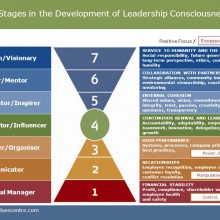
Stages in the Development of National Consciousness
By Richard Barrett
Overview
All human group structures grow and develop in seven well-defined stages. Each stage focuses on a particular existential need that is common to the human condition. These seven existential needs are the principal motivating forces in all human affairs. The level of growth and development of all human group structures depends on the ability of the leaders to create the conditions that enable the members of the group structure to satisfy these seven existential needs. If these needs are not met, then the consciousness of the people in the group structure will stay focussed on these needs until they are met. The following diagram shows the needs associated with each stage in the growth and development of nations.
Stages 1 to 3, focus on the basic requirements of nations – protection, safety, and economic security at stage 1; a sens
Read more ...